

Let Your Work Flow
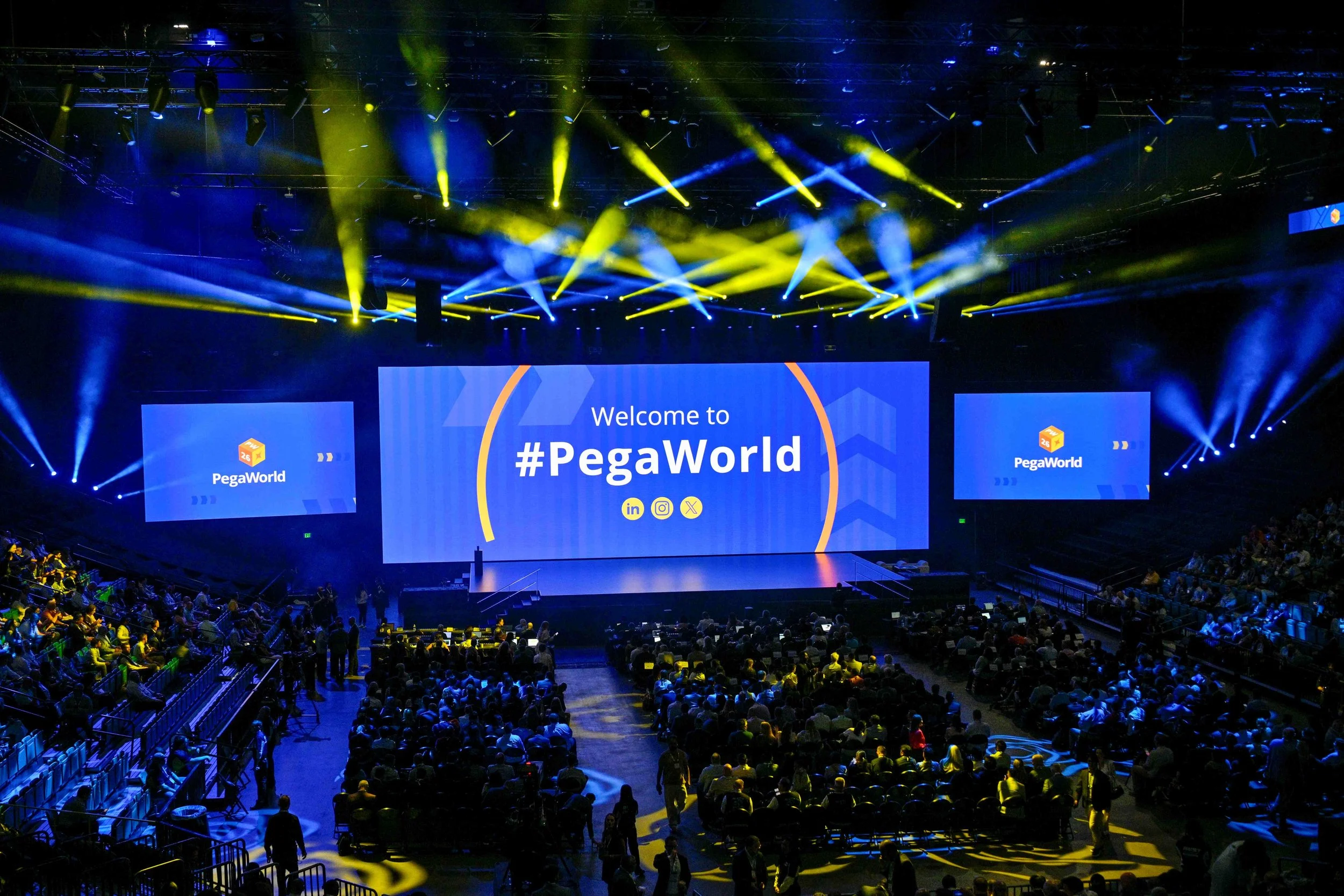
At PegaWorld 26 in Las Vegas, Pega Systems shared the Blueprint for success.
At PegaWorld 26, Pega Systems’ leadership, including CEO Alan Trefler, addressed the current volatility of enterprise AI, specifically targeting the unreliability and escalating token costs associated with prompt-based generative AI. To counter the “illusion” of magical AI solutions, Pega introduced a more structured, deterministic approach to enterprise automation.
The MGM Grand Garden Arena in Las Vegas has hosted some of the most recognisable names in boxing history.
Whether that’s Mike Tyson, Floyd Mayweather, or Tyson Fury, the arena is well accustomed to ‘big hitters’ making even bigger swings.
On the morning of June 8, Alan Trefler, the Founder and CEO of Pega Systems, graced the stage to open PegaWorld 26, taking aim at inconsistent AI outputs, rising token costs, and the need for predictable outcomes and costs.
“This is an enormously fraught, enormously confusing, and enormously important time,” said Trefler. “For the last couple of years, we’ve been exposed to AI, and fed these little tokens by the drug dealers to get us sort of hooked.
“All of this creates the sense that there is something magical here, and that somehow this magic would convert itself into just a utopia that would take so many of our operational, administrative, customer problems, make them better, boost organisations in ways that they might not have conceived of before.”
Behind the Illusion
It was expected that Artificial Intelligence would dominate the early part of the presentation. In an attempt to remain relevant and keep prices in check, it seems everyone is searching for ways to weave technology into their products or solutions.
At PegaWorld, Trefler, along with Chief Product Officer Kerim Akgonul, demonstrated how businesses can use BluePrint, the AI application designer from Pega, to create agents based on workflows rather than prompts. On stage, Trefler said that “customers want to talk to [AI agents] conversationally, and we want to be able to do this without having you write prompts”, citing that these prompts are “a lot less reliable than having a workflow”, because the agent can not always understand exactly what is being asked of it.
With Blueprint, Pega has provided a solution to the prompt problem, allowing businesses to ensure agents perform time- consuming tasks for employees.
“AI plays a central role throughout your journey from design to build to run,” said Akgonul. “Each step of the way, Pega will provide a visual experience, so you can actually see and understand what we’re working on without having to read those thousands of lines of code.”
“With the latest capabilities of Blueprint AI, we’ve gotten to the point where the more intricate details of this construction can be captured and perfected in this design period.”
Un-Token Maxing
The decision to restructure how agents are built means that anyone who builds an agent in Blueprint can draw on Pega’s capabilities.
Blueprint runs on Pega’s own metadata and pattern library, which lets it reuse much of the prebaked knowledge instead of building an entirely new application from scratch, regardless of how much needs to change. In turn, this means that LLM usage is kept to a minimum and only drawn on when absolutely necessary.
On stage, Trefler compared the repeatable processes in every business that AI agents are designed to perform to a recipe, where the core components stay the same, but there can be small changes each time you cook.
Trefler also hailed Blueprint as “a terrific use of AI” but added that it is “as hungry for tokens as anything you’ll ever see,” even though it is free for anyone to use.
“We thought it was important to our customers that we gave it away for free because it allows customers to rethink what they do. For every Blueprint of a recipe, they’re going to produce it hundreds, thousands, tens of thousands of times, so the aggregate cost is very modest.
“Contrast this to the way that the agentic folks talk about reasoning and wanting to re-reason every single time you do something; we think this is madness.
“We think that the workflow recipe mindset is an architectural mindset for your businesses and may not be 100% of what you do, but let’s face it, a tremendous amount of every business has similarity, and you should look there before you go burn tens of thousands of tokens to make something up from scratch that might not give you a reliable answer.”
Keeping Up with the Times
Along with tens of thousands of tokens, the other inflation the businesses are grappling with is the lines of code that generative AI produces.
As if that wasn’t hard enough, the volume of code is intertwined with mistakes created by generative AI. Standing in front of an AI-botched picture of his dog, Muffin, during his keynote address, Akgonul said, “AI always goes back very confident, but it’s not always very accurate.”
“When the AI is graphical, you can spot the mistakes or the imperfections. But if the mistakes are buried in thousands of lines of code, that’s not so easy to see, because we all know that AI-generated code is very verbose. I worry that having thousands of engineers generating excessive lines of code is not going to work out swimmingly for those mission-critical applications.
“How do you spot the obvious mistakes? The question isn’t whether we’re going to use AI, but how we use it to make things simpler, not more complicated.
“We’re all out there trying to deliver experiences for employees, and for our end customers that are easy, simple, and fast, and every company is trying to deliver that seamless experience across an enterprise architecture that is already really complicated.”
Akgonul added that using artificial intelligence to write code only increases complexity within these businesses. However, he added that AI also presents an opportunity to modernise applications that may well have been created over two decades ago.
“Every organisation in this room has a bunch of old applications that are currently running mission-critical operations—some of these run back to the 80s and 90s.
“They’re written in languages that no one speaks. Some of them are from vendors that no longer exist, and many of them run on hardware you can only buy on eBay. And if I had to guess, they’re not really very good at the latest security patches.
“AI gives us an incredible opportunity to break free from all these outdated applications and modernise them to cloud-native, AI-enabled solutions like Pega.”
Man vs Machine
With so much talk about automation and the capabilities of artificial intelligence. The FAQ on everybody’s mind is: What happens to the humans?
By looking at automation and using agents through the lens of workflows, it could be argued Pega has been able to kick that particular can down the road. Despite openly acknowledging that AI will be coming for people’s jobs, Pega still sees it as a tool to increase productivity.
On stage, Don Schuerman, Chief Technology Officer and Vice President, Marketing and Technology Strategy and Rob Walker, Vice President, Decisioning & Analytics, ran through the advantages of the Customer Decision Hub (CDH). Attendees could see how a performance agent could spot a gap in the marketing plans and consult a marketing agent to create a brief for a new campaign, which the human marketing manager could validate and tweak.
“That’s so powerful,” said Schuerman, “it’s a way that we can drive more and better engagement, always keeping a human in the loop. “This is truly the best of both worlds. Statistical AI, deterministic workflows, but the capability of agents to be creative to find new solutions.
“I get to start working in a marketer’s voice, writing a brief in a way that marketers want to talk about the campaigns that they want to run.
“We create more relevant creativity, we can update what we’re doing, we can change our campaigns on the fly, we can get to the point where we can have content and engagement that is directly relevant and personalised to the employees.
At the moment, the human in the loop is there to answer the question of why the AI is performing certain tasks. With Schuerman getting excited about the possibilities on stage, Walker pumped the brakes: “Not too fast, you can do that in design time, in runtime you have to be deterministic. You have to be able to explain it. It has to survive an audit.”
“You need that explainable, auditable, predictable execution of runtime,” finished Schuerman, “but the freedom to iterate at design time. “Whether it’s a solution designer iterating in blueprint to think up a new business process, whether it’s a marketer iterating with the creative agents to come up with a new campaign, that design time iteration matched to that real-time predictable execution, that is where the magic happens.”
